
A loyalty manager at a mid-size restaurant group knows exactly who she wants to reach. Members who visited twice in the last 30 days, spent under $25 each time, haven’t redeemed a reward in two months and live within delivery range of the three underperforming locations. She has the idea in about four seconds and building the audience takes her twenty minutes.
She opens Filter Members. Visit count: greater than or equal to 2, in the last 30 days. Average spend: less than 25. Last redemption: more than 60 days ago. Location: three specific stores, selected one at a time from a dropdown that doesn’t remember what she picked five seconds ago. She checks it twice because a wrong filter doesn’t throw an error, it just quietly returns the wrong 4,000 people and she won’t find out until the campaign underperforms.
This is the part of loyalty marketing nobody puts in the case study: the twenty minutes of translation between the idea and the interface. AI audience segmentation for restaurants is built to close that gap.
The bottleneck was never the data
Most F&B groups running loyalty programs today have more customer data than they know what to do with. Visit frequency, basket size, channel preference, redemption history, location, tenure, etc. The data has been sitting there for years but what’s been missing is the ability to turn a plain description of a customer into a working segment without a filter-building session standing in the middle.
That gap matters more than it sounds like it should because segmentation isn’t a one-time setup task. It’s something a marketing lead needs to redo constantly: a new promotion needs a new audience, a slow Tuesday needs a different one, a product launch needs a third and so on. If each of those requires rebuilding conditions from scratch, the honest incentive is to reuse the same three or four segments over and over because building a new one costs too much time relative to the campaign it’s for. Personalization programs don’t stall because brands lack data about their customers but because acting on that data has a labor cost attached to every single campaign and marketers ration their time accordingly.
What the labor actually looks like at scale
It’s worth looking at how much operational work sits behind the loyalty segmentation that gets written up as strategy.
Sephora’s Beauty Insider program is often cited for its tiering: Insider, VIB, Rouge and each unlocking different rewards and access. What doesn’t make it into most write-ups is the maintenance behind that structure. Tier thresholds have to be recalculated as spending patterns shift. Members moving between tiers need to be re-segmented continuously, not just once a year. Rewards eligible to one tier and not another require the underlying member lists to stay current in real time or the experience breaks down at the point of redemption. The tiering feels effortless to the customer because a team is rebuilding the plumbing behind it constantly.
Starbucks Rewards runs on a similar principle, but through behavior rather than spend tiers. Members get segmented by order patterns, time-of-day habits, drink preferences and app engagement and those segments feed personalized offers delivered through the app. That system depends on someone continually defining new behavioral cuts as patterns change: a segment for members who order before 8am but haven’t visited in ten days is not a filter that exists by default. Someone has to think of it, then build it.
Both examples are held up as proof that segmentation works but less discussed is that both required standing infrastructure and ongoing labor to keep the segments current. Most mid-size operators don’t have a Sephora-sized data team on staff which is exactly why segmentation ends up being the bottleneck rather than the data itself.
Removing the bottleneck without removing judgment
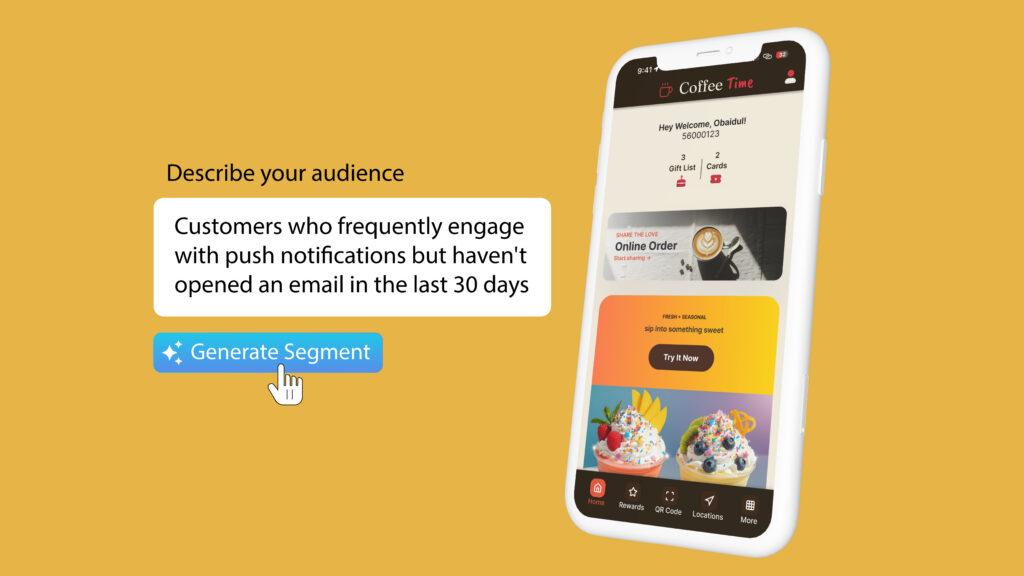
Como’s AI Free Text search, now in beta within Filter Members for merchants in the US, England and Australia, is built around a narrower idea: describe the audience instead of assembling it.
Instead of stacking conditions manually, a marketer types something closer to how they’d actually say it out loud. Members who visited twice in the last month but haven’t redeemed a reward in 60 days, near our downtown locations. The AI interprets the request, applies the matching filter logic behind the scenes and returns the audience. Complex requests can take 20 to 60 seconds to process, which is a fair trade for what used to take twenty minutes of manual condition-building and a second pass to check for mistakes.
The part worth paying attention to is what happens after the results come back. The tool displays a summary explaining how it interpreted the request, so the marketer can confirm the criteria actually match what they meant before the segment goes anywhere near a live campaign. That step is the difference between AI doing the grunt work and AI making the call. The interpretation is visible, checkable and rejectable and the marketer still decides whether the segment is right. That distinction is the whole point of the feature. Natural-language filtering doesn’t replace the judgment of someone who knows their customer base, it removes the mechanical translation step between having the idea and testing it, so more ideas actually make it to a live campaign instead of dying in a dropdown menu.
Three questions to ask before trusting an AI-generated segment
AI segmentation is quickly becoming a category term people search for and the beta features shipping now will shape what “good” looks like before most operators have settled on how to evaluate them. Before treating any AI-generated audience as campaign-ready, a few questions are worth running through every time:
- Does the summary actually match the intent or just the keywords? An AI interpreting “customers who feel neglected lately” and a marketer meaning “no visit in 45 days” can produce a summary that looks reasonable at a glance but encodes the wrong threshold. Read the interpretation line by line and don’t just check the headline.
- What’s the size of the result and does it make sense? A segment that returns 40 people when the operator expected 4,000 or the reverse, is a signal that something in the interpretation went sideways before a single message goes out.
- Would this segment survive a manual filter check? For high-stakes campaigns, particularly the first few times a team uses the feature, it’s worth rebuilding the same segment manually and comparing the results. Once the interpretation logic proves reliable for a given type of request, that verification step can fade. Early on, it’s the fastest way to build calibrated trust in the tool.
Segmentation has always been the layer standing between a good campaign idea and a live one. Data was rarely the constraint, the time and labor required to translate an idea into a filter was. Removing that translation step means more of a marketing team’s good ideas get tested instead of shelved.