The most expensive restaurant promotion mistakes do not look like mistakes on launch day.
In August 1992, Hoover UK launched an offer that sounds made up. Spend £100 or more on Hoover products and get two free return flights to Europe, worth roughly £600. By November of that year, the destinations included the United States.
The maths was never going to work, and Hoover knew it. The plan relied on most customers not bothering to claim or failing the conditions buried in the terms. Internal projections put applications at around 50,000 ad roughly 300,000 came in. Customers worked out very quickly that a £120 vacuum cleaner was the cheapest flight to New York available anywhere. People bought appliances they did not want, kept them in boxes and even filed their claims. Hoover could not process the volume, started rejecting applications on technicalities and eventually ended up in front of regulators and in court. Management Today puts the eventual cost at £48 million. Hoover’s European business was sold to Candy in 1995 and never recovered.
Nobody at Hoover failed to sell vacuum cleaners because the campaign did actually work, which was the problem!
This is the pattern worth paying attention to as you go into the holiday season. The promotions that destroy a budget are almost never the ones that underperform. A flop is cheap, it costs you the production time and some list fatigue, and you move on. The expensive ones are the campaigns that succeed past a limit nobody set.
KFC in the month of May, 2009. KFC launched its new grilled chicken by giving away free two-piece meals through a downloadable coupon promoted on The Oprah Winfrey Show and Oprah.com. The coupon was available for 24 hours and millions of people downloaded it.
Then the lines started. Restaurants ran out of chicken, out of sides and in some cases simply stopped accepting the coupon. Customers who had queued were turned away and within days KFC suspended redemption entirely, in fact the US president at that time Roger Eaton apologised publicly and offered rain check forms so people could claim once stores were restocked.
The demand forecast was not the failure, no forecast survives Oprah. The failure was that the campaign had no ceiling on how many coupons could be redeemed in a day, or at a store or in total. Distribution was unlimited and redemption was uncapped, so the only thing that could stop the promotion was the kitchen running dry. Cap redemption volume, not just distribution. Those are two different numbers and only one of them is under your control after launch.
Pepsi, in the year 1996. A Pepsi Stuff commercial ended with a teenager landing a Harrier jet at his school, captioned at 7,000,000 Pepsi points. Points could be bought outright at 10 cents each. John Leonard raised $700,000 from investors, submitted an order, and sued when Pepsi declined to deliver a $23 million military aircraft.
Pepsi won. In 1999 Judge Kimba Wood ruled that no objective person could reasonably have concluded the commercial was a real offer. Pepsi had also already re-cut the ad to read 700,000,000 points and added a joke disclaimer. Read that outcome carefully, because the lesson is that they spent three years in federal litigation over a figure in a television ad. They won on the argument that the offer was obviously absurd.
Ambiguity in campaign terms is a liability even when you are right.
The restaurant promotion mistakes hiding in your own setup
You are not giving away jets. But the mechanism is identical anyway and in F&B it usually looks like one of four things.
- A deal that stacks with another deal nobody checked it against, so a £12 order arrives at £3.
- A campaign with no end date on it, launched for a slow Tuesday in February and still live in June.
- A reward with no per-member limit, which one member with a spreadsheet finds and runs forty times in a weekend.
- A points item priced wrong, where the error is invisible until the balances are gone and you are deciding whether to honour it.
None of those are strategy failures because the thinking was fine. They are configuration errors and they share a specific quality: they look correct in the setup screen and only reveal themselves in the transaction data, which is to say after the money is gone. That gap between the setup and the behaviour is where most promotional losses actually live.
What we built for it
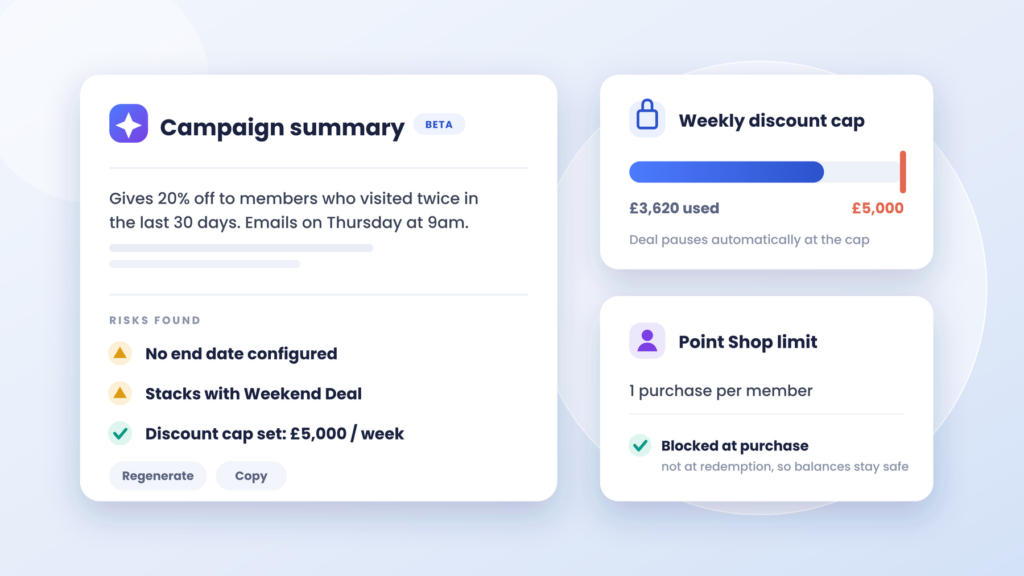
AI Campaign Summary reads your campaign configuration and explains it back to you in plain language. It covers triggers, conditions, actions, asset issues, communications and validity rules, with a short overview and a full breakdown, and it flags inconsistencies and configuration risks before anything goes live. Activities with multiple cases can be reviewed as a whole or drilled into case by case, and summaries can be regenerated if one reads badly or copied out for sign-off. Deals are now included. It is in beta and enabled automatically for businesses in the UK, US and Australia, and it shows as an AI Summary column in Campaign Center. Promo codes and punch cards are not supported yet.
The value is not speed, though it is faster. The value is that reading a description of your own campaign is a different cognitive task from reviewing the form you just filled in. You catch things in the first that you are blind to in the second.
Monetary discount limits per Deal let you cap total discount value by day, week, month or year, on top of the usage-count limits that already existed. When a deal hits its cap inside the active period it becomes temporarily ineligible and drops out of Loyalty API benefit responses until the timeframe resets. This is the Hoover control. It converts an open-ended liability into a number you chose.
Point Shop per-member purchase limits block the transaction at purchase time rather than at redemption, so a member’s balance is protected before it is spent rather than disputed afterwards. Purchases are tracked per member atomically, so one member hitting their limit does not affect anyone else and the overall purchase count is exposed in the Hub.
Five questions before you hit launch
Run these on your next campaign and you will see that each one maps to a failure above.
- What is the maximum this costs me if every eligible member redeems? If you cannot answer in a number, you have not set a cap, you have set a hope.
- How many times can one member claim this? Name the figure. “Once” counts as an answer. “Nobody would do that twice” does not.
- When does it end, and is that date actually configured? Not planned. Configured.
- What else is live that this could combine with? Check the overlap deliberately rather than assuming the stack is impossible.
- If someone wanted to abuse this, what would they do? Spend two minutes thinking like the person who found the £120 flight to New York. They exist in every member base and they are reading your terms more carefully than you are.
Generous offers are fine but such offers without ceilings are how a marketing budget becomes then a finance problem.