There’s a version of your brand your customers experience that you’ll never fully see. It’s not your campaign, not your carefully designed app and definitely not the clean journey map sitting in your strategy deck. It’s the version they encounter when they’re tired, distracted, overstimulated and just trying to get through their day without making ten unnecessary decisions. And during Stress Awareness Month, it’s worth confronting something most brands would rather ignore: a lot of customer experiences don’t reduce stress, they quietly add to it.
Why Stress Happens in Customer Journeys
This doesn’t happen because brands are careless. It happens because they design for ideal conditions instead of real ones. Customers are not opening your app with a clear mind and unlimited patience. They are already mentally overloaded. In fact, research by Accenture’s The Empowered Consumer shows that 73% of consumers feel overwhelmed by too many choices, while 75% feel constantly bombarded by advertising. By the time they reach your platform, they’re not looking for more options or more messages. They’re looking for ease, clarity and a sense that something, at least for a moment, is simple.
The Invisible Signs of Stress
What often gets overlooked is that stress in the customer journey rarely shows up as explicit frustration. It doesn’t always come through complaints or negative reviews. Instead, it appears as- Hesitation
– Abandoned carts
– Shorter sessions
– A quiet decision to choose another brand next time.
These are the moments where loyalty starts to erode, not because of one major failure, but because of a series of small, exhausting interactions that make the experience feel harder than it should be.
Many of these stress triggers are hiding in plain sight.
Too much choice
Endless scrolling and overly detailed menus can feel empowering in theory, but in reality, they demand effort. Decision fatigue is real, and when customers are already drained, they don’t want to build their perfect order from scratch. They want guidance. They want familiarity. They want something that feels easy.
Poor Timing
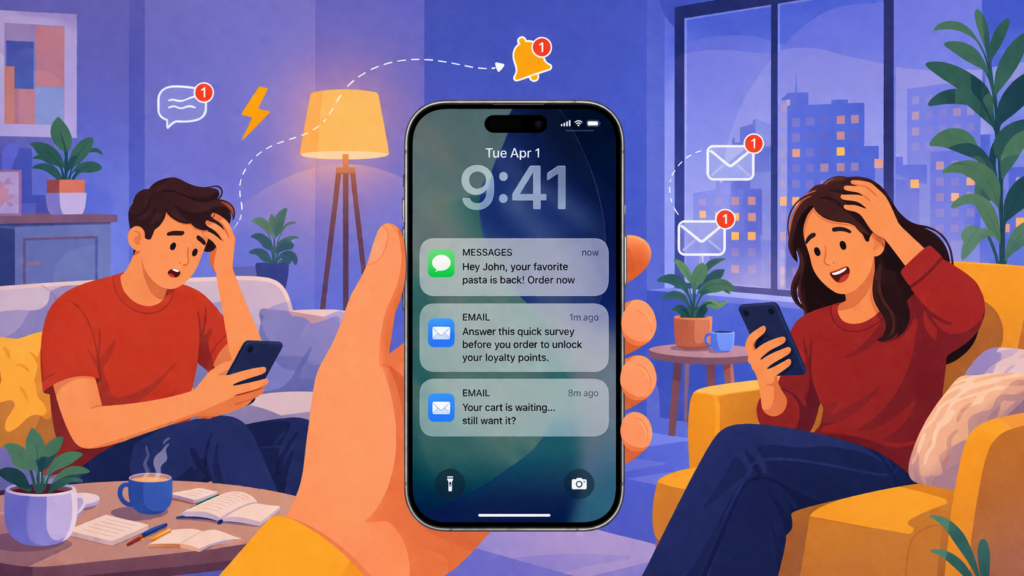
Timing is another subtle but powerful trigger. Messages that arrive at the wrong moment, offers that appear after a purchase is already complete, or notifications that interrupt instead of assist can quickly turn from helpful to intrusive. According to 2025 Optimove Insights Consumer Marketing Fatigue Report, around 60% of consumers report that they frequently receive poorly timed messages from brands, which only adds to the sense of being overwhelmed. When communication feels out of sync, it doesn’t just get ignored, it creates friction.
Repetition and Overload
Repetition makes things worse. Seeing the same offer multiple times doesn’t reinforce value, it creates fatigue. In fact, consumers say they unsubscribe from brands that bombard them with repetitive messaging. What brands often interpret as persistence, customers experience as noise. And once that line is crossed, it’s very difficult to win back attention.
Complexity disguised as Functionality
– Multiple steps
– Unnecessary logins
– Slow-loading interfaces
– Unclear navigation
Each individual friction point may seem minor, but together they create a journey that feels unnecessarily demanding. When customers are stressed, even small inconveniences feel amplified.
The impact of all this is rarely immediate, but it is significant. Loyalty is not usually broken by one dramatic failure. It’s worn down gradually through moments where the experience feels frustrating, confusing, or simply not worth the effort. Studies show that 32% of customers will stop engaging with a brand they like after just one poor experience, as cited by PwC’s customer experience studies. That “poor experience” is often nothing more than a moment where things felt harder than expected.
Opportunities for Brands During Stress Awareness Month
This is where the opportunity lies. Stress Awareness Month is not just a moment for reflection, it’s a chance for brands to rethink what they are actually delivering to their customers. At Como, we see loyalty not just as a system of rewards, but as a way to create experiences that feel intuitive, predictable, and genuinely supportive. When customers don’t have to think too hard, when their preferences are understood, and when interactions feel seamless, the entire experience becomes lighter.
Reducing stress in the customer journey doesn’t require dramatic reinvention. It starts with simplifying choices, improving timing, reducing unnecessary communication and designing interactions that respect the customer’s mental state. It means shifting from “How much can we offer?” to “How easy can we make this feel?” Because in a world where people are constantly overwhelmed, the brands that stand out are not the loudest or the most complex. They are the ones that feel effortless. And that feeling, more than any campaign or promotion, is what keeps customers coming back.